AI and Robotics for Automated Genetics
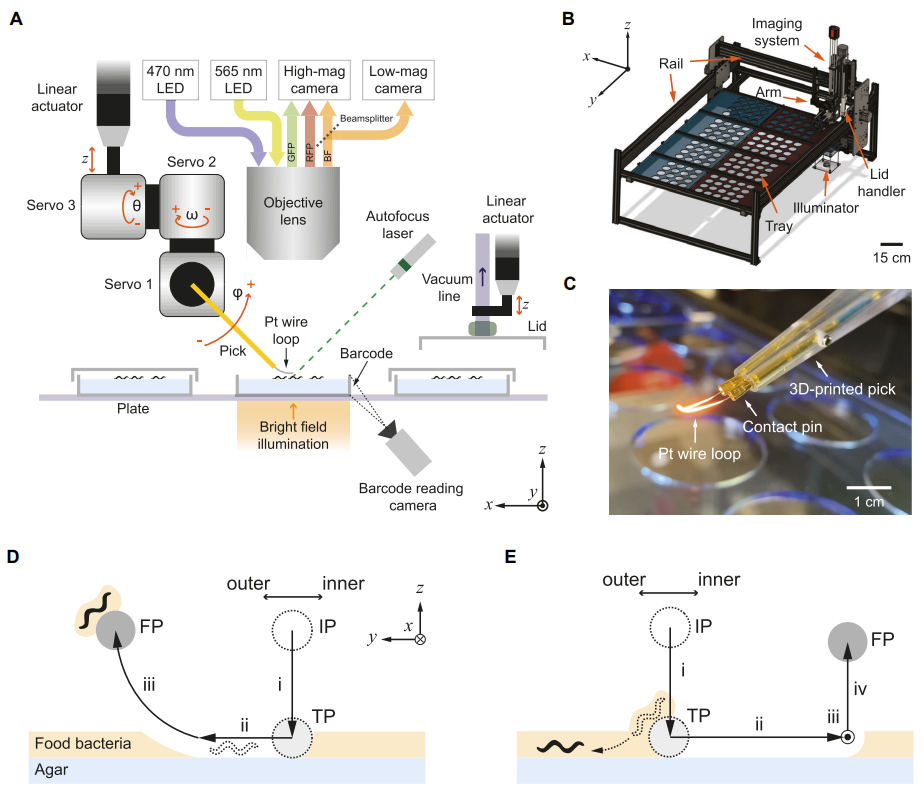
As part of my PhD thesis, I developed WormPicker, a robotic system designed to automate the genetics of Caenorhabditis elegans, a small roundworm that has become one of the most important model organisms in biology. By combining multimodal imaging, AI-powered computer vision, and adaptive motion control, the robot can identify individual animals with desired traits and transfer them automatically between plates, at a speed comparable to human researchers. This addresses one of the most labor-intensive steps in C. elegans research, enabling scientists to perform genetic manipulations and screening workflows at greater scale. A next-generation system, WormPicker 2.0, is now under development and is expected to operate at least five times faster.
Z. Li, A. D. Fouad, P. D. Bowlin, Y. Fan, S. He, M. Chang, A. Du, C. Teng, A. Kassouni, H. Ji, D. M. Raizen, and C. Fang-Yen, ”A robotic system for automated genetic manipulation and analysis of Caenorhabditis elegans”, PNAS Nexus (2023) https://doi.org/10.1093/pnasnexus/pgad197
Featured in EurekAlert!, Phys.org, and OSU BME.
High-throughput Screens for Gene Discovery
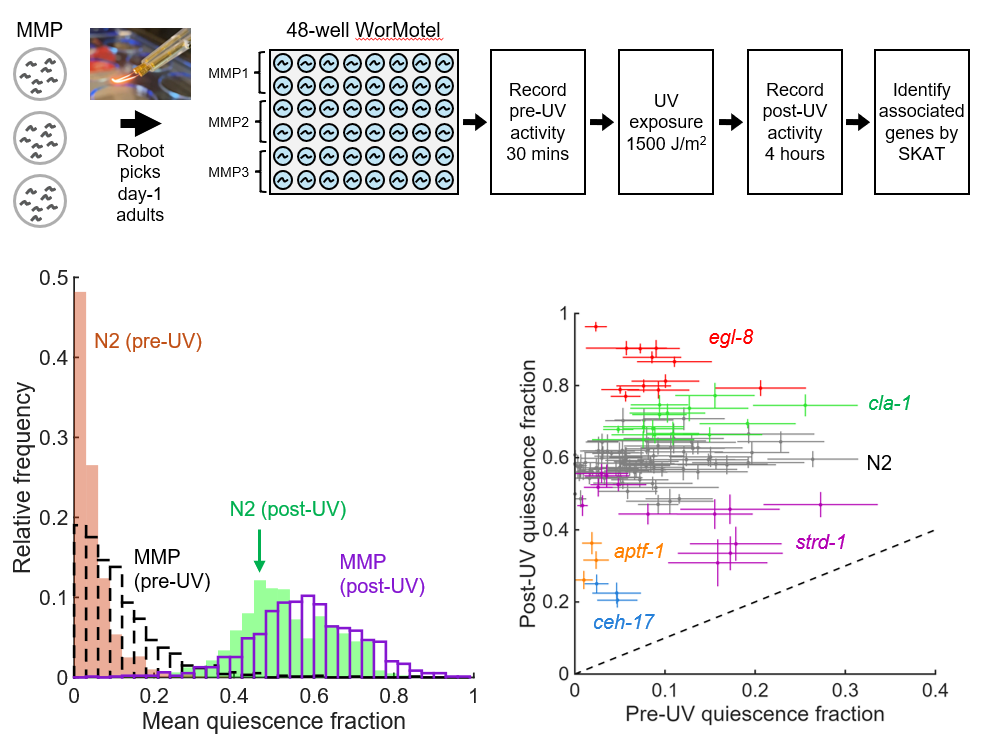
Genetic screens using model organisms, such as C. elegans, provide a powerful approach for identifying important regulators of biological processes. However, conventional genetic screens have relied on low-throughput manual procedures, which limit screening scale and discovery power.
To overcome this bottleneck, I used the WormPicker robotic system to perform a large-scale screen for genetic modulators of sleep in C. elegans, a labor-intensive task that would be difficult to accomplish manually. By combining this automation platform with computational genomic analyses, we discovered multiple novel genes whose disruption causes changes in sleep, providing new insights into the mechanisms underlying sleep regulation.
Z. Li, H. Honarpisheh, S. Kutagulla, K. LeCure, J. Liang, D. Raizen, and C. Fang-Yen, ”A semi-automated genetic screen using genome-wide association analysis identifies modulators of stress-induced sleep in Caenorhabditis elegans”, G3: Genes|Genomes|Genetics (in press) https://doi.org/10.64898/2026.05.16.725661
High-Contrast Imaging by Modulating Light Scattering
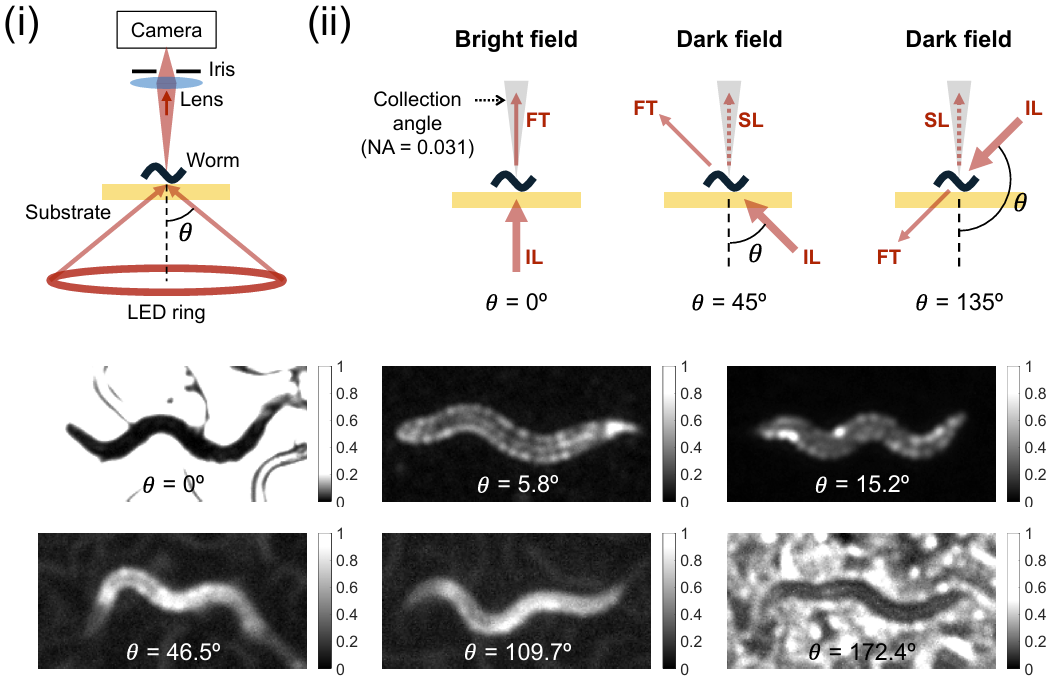
Biological tissue strongly scatters light, making it difficult to visualize fine structures with high contrast and posing a central challenge in biomedical imaging. My research explores how optical scattering can be better understood and controlled to improve image contrast. Using novel measurement techniques and computational modeling, I developed a new mechanistic framework to describe optical scattering from biological specimens with specific geometries, for example C. elegans. I further developed innovative light-field modulation methods to show how scattering can be manipulated to enhance important visual features.
Z. Li and C. Fang-Yen, "Mechanisms of surface and volume light scattering from Caenorhabditis elegans revealed by angle-resolved measurements", iScience (2026) https://doi.org/10.1016/j.isci.2026.116117
Z. Li, Z. Yu, H. Hui, H. Li, T. Zhong, H. Liu, and P. Lai, ”Edge enhancement through scattering media enabled by optical wavefront shaping”, Photonics Research (2020) https://doi.org/10.1364/PRJ.388062